

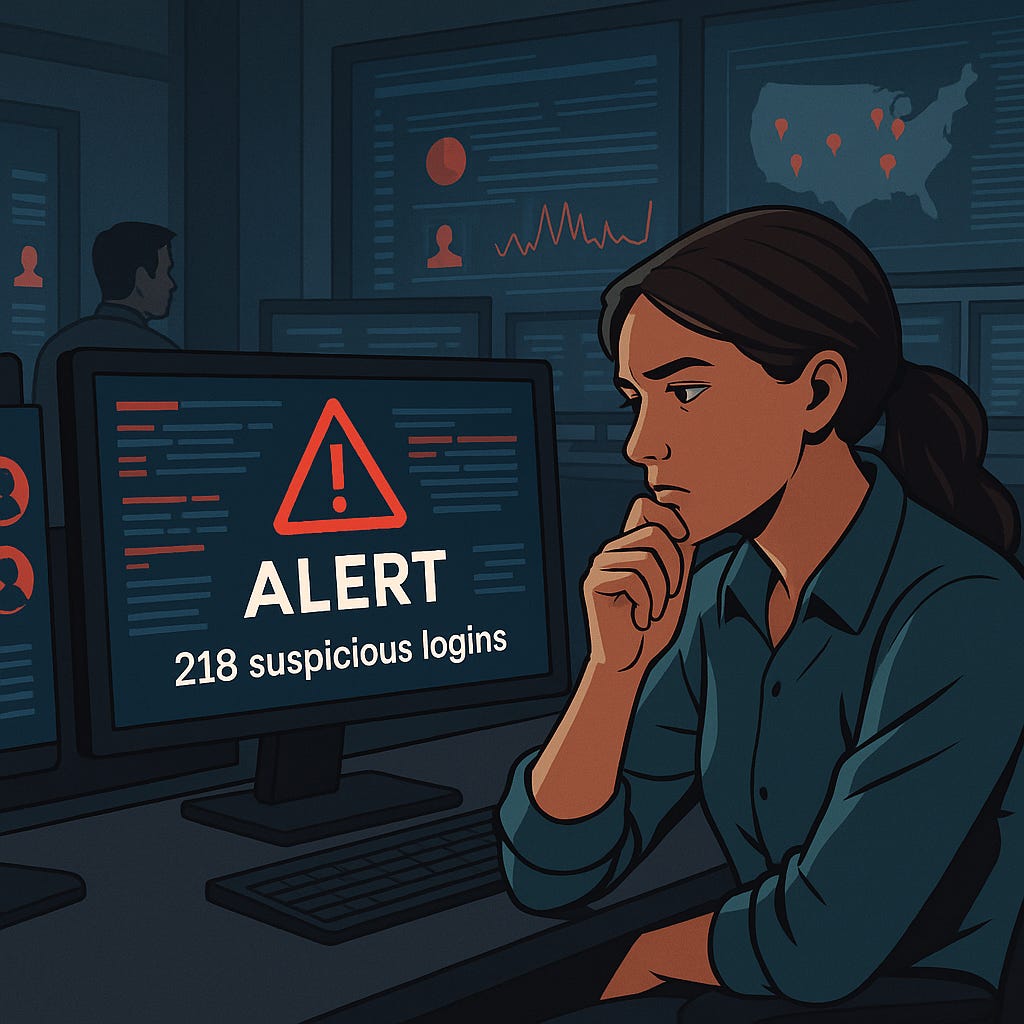
On a quiet Monday morning, the SOC dashboard lit up like a Christmas tree—red alerts everywhere.
Layla, the senior security analyst, slid her chair closer and frowned.
“Not again,” she muttered.
The AI detection system had flagged 218 employee logins as potential account takeover attempts.
That number made no sense.
Layla opened the logs. Same pattern. Same confidence score. Same “suspicious behavior.”
And then she saw it:
Every single flagged login came from the company’s new satellite office in Denver—the one that opened three days ago.
The analysts had never labeled any “normal Denver login” in the training data… and the model was confidently classifying every login as “abnormal.”
Not because Denver was risky.
But because Denver didn’t exist in the model’s past reality.
That’s the moment Layla leaned back in her chair and whispered to herself:
“This is supervised learning… doing exactly what we taught it.”
A Flashback: How the System Learned in the First Place
Months before the Denver office opened, Layla’s team trained the cybersecurity model using supervised learning:
These logins = normal
These patterns = malicious
These IP ranges = safe
These behaviors = risky
The model didn’t learn right from wrong.
It learned patterns—patterns rooted in the company’s past.
Supervised learning is like telling a child:
“Every time you see this shape, call it a triangle.”
Useful. Efficient. Powerful.
But also limited.
If the child encounters a new shape it’s never seen before—say, a four-sided star—it will try to fit it into one of the patterns it already knows.
That’s exactly what happened to the Denver office logins.
Where This Gets Interesting (and Dangerous)
At lunchtime, Layla walked her junior analyst, Rami, through what went wrong.
“It’s not that the model is bad,” she explained.
“It’s that models trained by supervised learning can only recognize the world they’ve been shown.”
Rami nodded.
“So it panicked because it saw something new?”
“Not panicked…” she corrected.
“Confidently wrong. And that’s worse.”
Upsides of the System They Built
It detects phishing logins faster than humans ever could
It’s consistent, which auditors love
It follows rules defined by labeled examples, which fits neatly into NIST AI RMF and ISO 42001 workflows
Downsides That Denver Exposed
It can’t adapt to novel scenarios
It inherits every bias in the labeling
It can be poisoned if attackers sneak bad samples into the training data
It can fail loudly and confidently
Layla knew that the future of AI governance wasn’t just about accuracy—it was about understanding how AI fails.
A Movie Scene That Explains It All
Later that night, Layla watched Minority Report—a film she loved long before she worked in security.
The “PreCrime” system in the movie also relied on past labeled patterns:
Input behavior → Output prediction
Patterns → Labels
Past → Future
It worked brilliantly…
until a scenario appeared outside the pattern, one the system had never been trained to see.
And suddenly, the entire system collapsed under the weight of its own confidence.
Just like the Denver logins.
In both cases, the AI wasn’t malicious.
Just limited by its training data, and blind to what it had never been taught.
The Resolution
The next morning, Layla updated the training data.
She labeled hundreds of Denver logins as normal.
She retrained the model.
She added controls to monitor “new behavior drift.”
She wrote a post-mortem about model governance for leadership.
And she told Rami:
“Supervised learning isn’t dangerous.
It’s just honest.
It reflects everything we put into it—and nothing we forget.”
The dashboard turned green again.
The model was working.
But more importantly, now the humans were governing it, not the other way around.
Takeaway for AIGRC Readers
Supervised learning is powerful—but only within the boundaries of its labeled past.
In cybersecurity and AI governance, its risks emerge when:
new patterns appear
old biases remain
labels carry assumptions
attackers manipulate the data
humans assume the model “understands”
It doesn’t understand.
It recognizes.
And it recognizes only what we show it.
That is both its strength—and our responsibility.